

Best 5 CamerasYou can buy to start your journey as a Beginner Film-Maker In 2022
- Maitreya Pawar

- Jul 22, 2022
- 6 min read
Updated: Aug 11, 2022
Best 5 CamerasYou can buy to start your journey as a Beginner Film-Maker
1. SONY Alpha 6400

The main highlights are the Real-time Eye AF and Tracking autofocus features, an updated image processor, and a 180-degree flipping touchscreen. At 89,990 for the 16–50mm kit lens on amazon.in, the a6400 has the parts to be the ideal compact powerhouse for any photography enthusiast, or beginner filmmaker.

Videographers should know its support for S-Log 2, S-Log 3, and Hybrid Log Gamma (HLG). There are also 4K 24 / 30 fps shooting modes and they look great, but there’s no headphone jack — there’s only a mic port — which is a bummer and essential if you want to check on the audio status of video you’re recording.
DISPLAY:
The 921k dot resolution display on the a6400 is bright, sharp, and capable of moving 180 degrees to a selfie position, but I have more than a few gripes with it. Besides lacking touch control in the menus, the screen bumps into the viewfinder eyecup when you try to get the full 180-degree position.

FULLY ARTICULATED DISPLAY ~ CREDIT PIC: THE VERGE
TheThe Sony a6400 is a well-equipped camera with solid image quality and a great price considering its specs. I was impressed with the real-time tracking AF abilities and focus times, but it’s absolutely far from perfect. While some of the a6400’s new features (like real-time tracking) are especially exciting for a camera of this size and price
CHECK OUT FULL DETAIL ABOUT SONY ALPHA 6400
SHOT ON SONY A6400
2. FUJIFILM XT3




The X-T3 brings with it a brand new sensor, improved autofocus and video performance that makes it competitive with Panasonic’s GH5, taking the X-T series from being a very good stills camera to one of the best stills/video hybrids on the market. With its classic looks, attractive photos and superb video, it’s the APS-C camera to beat.
KEY FEATURES :
26MP BSI ‘X-Trans CMOS 4’ sensor
425-point hybrid AF system
Improved AF Tracking and Face/Eye Detection AF
20 fps shooting with AF (11 fps with mechanical shutter)
30 fps shooting in 1.25x crop with an electronic shutter
‘Sports Finder’ mode gives a preview of the area around a 1.25x crop
3.69M-dot electronic viewfinder
Three-axis tilting touchscreen
10 bit 4:2:0 H.265 internal video capture (4:2:2 over HDMI)
UHD/DCI 4K/60p from 1.18x crop region
UHD/DCI 4K/30p using the full width of the sensor
Internal F-Log capture (HLG coming by end of 2018)
Dual UHS-II SD card slots
USB C-type connector can be used for charging battery
Headphone and Mic Sockets
You can get it between 90,000 TO 1,00,000(BODY ONLY) and 18–55mm for 129,990

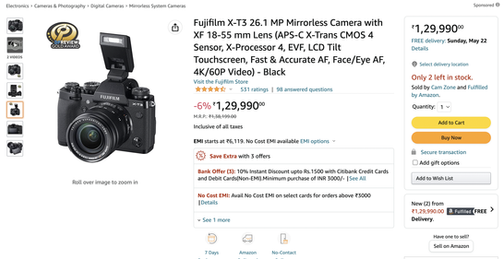



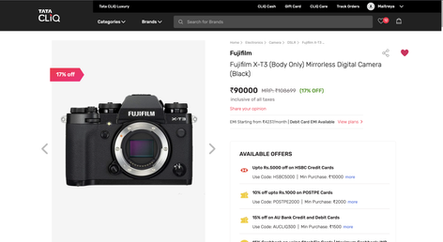
FUJIFILM XT-3 ON TATA CLIQ & FUJIFILM XT-3 AT AMAZON.IN
FUJIFILM XT-3 VS CANON 5D MARK IV PHOTOGRAPHY COMPARISON
FILMMAKING ON FUJIFILM XT-3 VIDEO/PHOTO
FILMAKING ON FUJIFILM XT-3
3. FUJIFILM XT-4

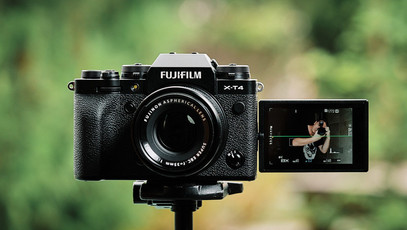




FUJIFILM XT-4
Fujifilm X-T4 is a mirrorless camera with a split personality — on the outside, it’s all retro dials and analogue chic, but inside it’s packed with more advanced features than we’ve seen from any Fujifilm X-T camera so far.
It’s a compelling combination. Like the Fujifilm X-T3 (which remains on sale), the X-T4 is for keen amateur photographers and pros who want the latest mirrorless power in a fun, desirable package. The difference this time is that the X-T4 has cranked its ‘all-rounder’ dial up to 11.
The headline news is the inclusion of in-body image stabilization (IBIS), making this only the second Fujifilm camera to have this feature, the other being the Fujifilm X-H1.
The Fujifilm X-T4 is slightly larger and heavier than the X-T3
Built quality is very solid, though a chunkier handgrip would be nice
Its magnesium alloy design is still weather-resistant
Now we come to the LCD touchscreen. The resolution of the 3-inch display is upped to 1.62-million-dots, and now the unit is fully articulated rather than a tilt type.
With the LCD screen flipped out to the side, it can be rotated and viewed in ’selfie’ mode. A front-facing screen is particularly useful for filmmakers that work alone. The screen can also be safely folded away to reveal a lovely faux-leather finish. We have particularly enjoyed a screen-less experience and focusing on the EVF instead.
Then there is a movie shooting spec that stands firm today too; Cinema 4K movies up to 60fps, 10-bit internal recording plus HDMI out, up to 400Mbps bit-rate and with F-Log and HLG profiles included as standard. Slow-motion Full HD movies are possible up to 240fps, too. If you want great looking videos, the X-T4 will achieve that.
The X-T4 has Fujifilm’s best image stabilization system so far
Face and Eye Detection AF are very impressive for portraits
15fps burst shooting makes it a strong action performer too
The X-T4 is also more than a X-T3 with IBIS. You get a much higher capacity battery, more robust shutter and some design changes that make complete sense for a hybrid camera.
Yes, almost all of the changes improve video capacity. But photographers are not left behind, benefitting from that better battery life, improved stabilization for non-stabilized lenses, plus a menu system and controls that are clearly distinguished for photo or video use.
In its own right, the X-T4 claims the crown of the best mirrorless camera with an APS-C sensor you can buy. It’s two powerful cameras in one, both of which you’ll have great fun using for many years to come.

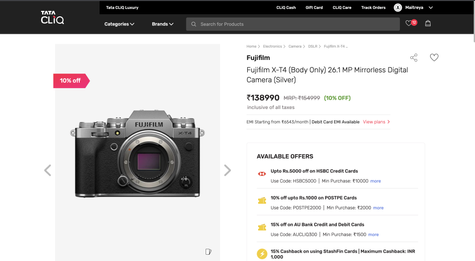

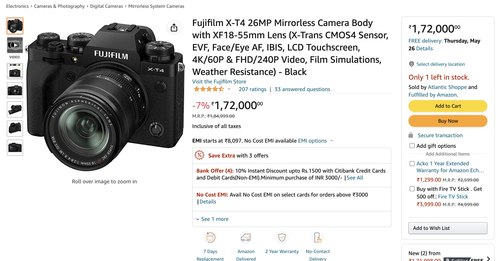
LOWEST PRICE ON TATA CLIQ & AMAZON.IN
FUJIFILM XT-4 REVIEW
SHOT ON FUJIFILM X-T4
SHOT ON FUJIFILM XT-4
SHOT ON FUJIFILM XT-4
4. SONY A7III

CREDIT: THE VERGE
Despite its billing as a ‘basic’ model, the Sony a7III is a supremely capable full frame camera. Though it doesn’t have the most megapixels or shoot the fastest bursts, its well-judged mix of resolution, speed, features and price point make it an easy recommendation for all kinds of photographers and also videographers.
KEY FEATURES :
24MP full frame BSI CMOS sensor
93% autofocus coverage (693 phase detection points, 425 for contrast detection)
Oversampled 4K/24p video taken from full width 6K (cropped-in 5K for 30p)
In-body image stabilization
10 fps continuous shooting
2.36M-dot OLED viewfinder, 0.78x magnification
AF joystick
Touchscreen
Larger, ‘Z-type’ battery (CIPA rated to 710 shots)
Dual SD memory card slots
USB 3.1 Type C
CREDIT: THE VERGE


SONY A7III VIDEO :
The Sony A7III has some impressive stats when it comes to shooting video. It shoots in 4K full frame video*, which is truly impressive. The image stabilization really shines during video shooting as well, and does a good (but not quite perfect) job of absorbing footsteps and general human shakiness. Video that you take with the A7III is going to be clear, stable and high quality.


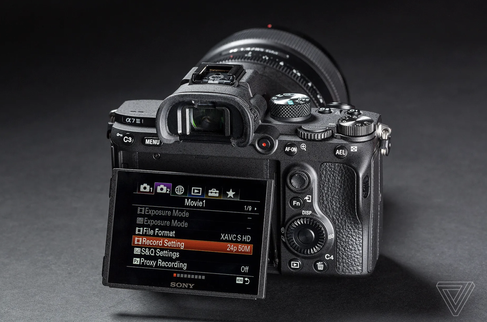
Full frame video means that the camera is able to take advantage of its entire field of view while taking video. This is critical because it allows you to fit more into the frame while being closer to the subject, which lets you take crystal clear high quality video.


SONY A7III (BODY ONLY)SONY A7III 28–70MM ZOOM KIT LENS
SONY A7III REVIEW
SONY A7III FOR PHOTOGRAHERS
5. SONY A7C




Sony A7C specifications
The Sony A7C uses a 24-megapixel full-frame sensor with 693 on-sensor PDAF points and 425 contrast detection AF points. The BionzX image processor is capable of capturing up to 10fps burst shots with AF/AE tracking, real-time tracking focus with the dedicated AF-On button, and real-time Eye AF for humans and animals. The camera has a native ISO range of 100–51,200, which is expandable.
The A7C also has similar video capabilities as the A7 III. It can shoot at up to 4K 30fps, and there’s a dedicated S&Q mode for slow-motion videos of up to 120fps (1080p). Advanced picture profiles such as 8-bit S-Log2, S-Log3, and HLG are supported.
The 2.35-million dot resolution EVF produces a crisp image, and the framerate can be bumped up to 120fps for smoother tracking of your subject. I wish Sony had provided a proper eye-cup around the EVF which could cover the user’s eye completely. Also, the magnification of the EVF is lower than before due to the smaller size, at just 0.59x compared to 0.78x on the A7 III, which makes the size of the viewfinder look smaller than usual. There’s built-in dual-band Wi-Fi which can be used for syncing with the Imaging Edge app on your phone.
The menu system of the Sony A7C is pretty much exactly what we’ve seen on other Sony mirrorless cameras such as the A7 III. It takes a bit of getting used to, but it’s feature-rich and functional once you get the hang of it.
The body of the Sony A7C is priced exactly the same (at the time of this review) as that of the A7 III, at Rs. 1,67,990 on Sony India's website but you can get for 147,790 Body only , which makes it a no-brainer to pick this camera over its older sibling and 172,290 with 28–60mm kit lens. The A7C offers pretty much the same features as the A7 III, but with improved autofocus and a rotating display, all in a more compact body. If you opt for the kit lens bundle, the A7C is comparatively more expensive on Sony's website, but both these cameras usually sell for less on other websites and offline, so it's just a matter of finding a good deal.
As good as the performance is, there are few things to keep in mind. The touchscreen still has limited functionality, the magnification of the EVF is on the lower side (even though the quality is good), and I think Sony could have chosen a brighter kit lens given the premium it charges for the bundle.
Overall, the Sony A7C is still a great camera for stills and video which offers all the benefits of a full-frame sensor in a compact and light body.
SONY A7C REVIEW
SONY A7C PHOTOGRAPHER'S REVIEW


SONY A7C BODY ONLY SONY A7C 28–60MM LENS


Comments